November. Two months left in the year, and December already looks like it will go by on fast-forward: closings, deliveries before the holidays, celebrations. Yet the annual review traditionally waits for the evening of 31 December, when nothing it turns up can still be corrected.
Done now, it still leaves several weeks to act.
Why review in November and not on 31 December
Symbolic dates have a real effect on motivation. In a study published in 2014 in Management Science, Hengchen Dai, Katherine Milkman and Jason Riis document what they call the fresh start effect: Google searches for the word "diet", gym visits and commitments to pursue a goal all rise after a temporal landmark (the start of a week, a month or a year, a birthday, a public holiday). Those landmarks push past failures back into a mental period that is over.
So 1 January makes a good starting line, provided the thinking happened before. The study by Norcross, Mrykalo and Blagys published in 2002 in the Journal of Clinical Psychology, "Auld lang syne", followed for six months 159 people who had made a New Year's resolution and 123 people with comparable goals but no resolution. At six months, 46% of the first group were still succeeding, against 4% of the second. Above all, the factors that predicted success (self-efficacy, skills, readiness to change) were measured before 1 January.
What research says about looking back
Looking back easily passes for time lost. A study by Giada Di Stefano, Francesca Gino, Gary Pisano and Bradley Staats says the opposite. In a Wipro technical support centre in Bangalore, employees in training spent the last fifteen minutes of each day writing down what they had learned. On the final training test, that group did 22.8% better than the control group, even though the control group had worked a quarter of an hour longer every day.
An annual review is the long version of the same habit: two hours to turn twelve months of vague impressions into findings.
The review in three passes, two hours
1. Gather the facts (45 minutes)
Memory is a poor historian: it overweights the last two months and wipes out the spring. Start by rebuilding the timeline from traces, not from recollections.
Four sources are usually enough: twelve months of calendar, the completed tasks, your project milestones and the notes taken along the way. In Flots, a project's milestones show what has been reached and what is left: a good thread for retracing the year project by project, including the delay you had forgotten.
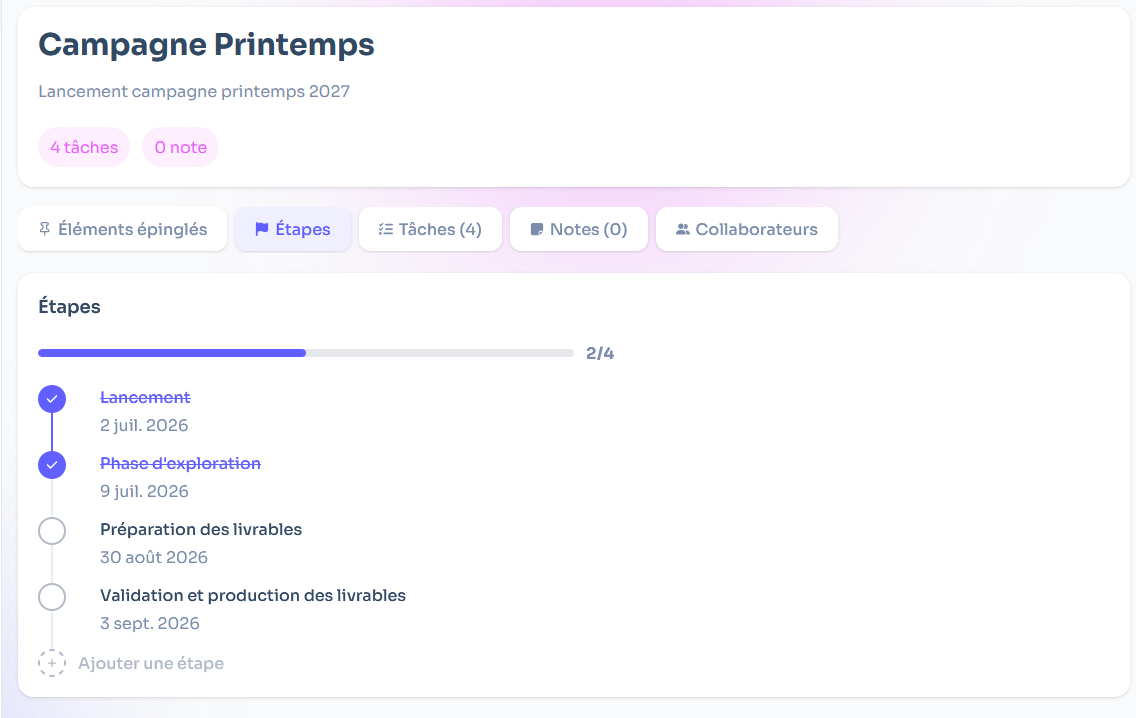
At this stage you judge nothing, you list.
2. Sort: keep, stop, change (45 minutes)
Three columns, and an obligation to fill all three. A review holding nothing but successes is a press release; a review holding nothing but failures is a settling of scores. Neither helps you decide anything.
| Column | The question | The trap |
|---|---|---|
| Keep | What produced a real effect? | Mistaking "it kept me busy" for "it counted" |
| Stop | What did I carry on out of habit? | Holding on to a commitment so as not to disappoint |
| Change | What half worked? | Wanting to rebuild everything instead of adjusting |
The "stop" column is the most useful and the most avoided: it is the one that frees up the time your new goals will need.
3. Decide what comes next (30 minutes)
Two or three directions, not twelve, and worded as actions. In an experiment published in PLOS ONE in 2020 with 1,066 participants, resolutions aimed at doing something held up better after a year than those aimed at avoiding something, with 58.9% success against 47.1%.
In practice: "write a newsletter every two weeks" rather than "stop neglecting my communication".

Turning those directions into measurable goals
A goal that motivates, key results you can verify: the OKR method gives the frame that January resolutions often lack.
Discover the OKR methodThe calendar from November to January
Spread over three months, the exercise weighs on no single week.
| When | What | How long |
|---|---|---|
| Early November | The three passes of the review | 2 h |
| Late November | What can still be salvaged this year | 1 h |
| December | Nothing. You execute and you close. | 0 min |
| First week of January | You start what was decided in November | 30 min |
The late-November slot is the one everybody skips, and often the one that pays best: five working weeks are left, enough to chase a client, finish a project milestone or clear a file that has been dragging since March.
In January, take the opportunity to create three dated tasks, at the end of March, June and September: one hour of quarterly review each. Next year's review will start from notes, not memories.
The four mistakes that sink a review
The first is doing it from memory, which means judging only the last quarter. The second is doing it alone, when an hour of discussion with a partner or a colleague brings back what you had swept under the rug.
Then come the list of twelve resolutions, which guarantees that none will be followed, and the review at 11 pm on 31 December, glass in hand, with nothing written down the next day.
If the exercise feels heavy, it is often because everything stayed in your head all year. Making your mental load lighter deals with the problem upstream.
Block two hours in your calendar this week, before December decides for you.
Rebuild your year, decide the next one.