Bending Spoons closed its acquisition of Airtable on 4 September 2026. Six days later, the same company announced an agreement to acquire Miro. One acquisition closed, another agreed, in a single week: the question comes up for the teams using these tools.
Nothing changes right away. It is a good moment to check two or three things.
What the Airtable acquisition changes
The deal was announced on 4 August 2026 at an enterprise value of $1.285 billion, and the transaction closed a month later. The closing press release claims more than 500,000 customer organizations, and Luca Ferrari, CEO of Bending Spoons, says there that he intends to invest in the product, customer support and go-to-market.
The price is still a long way from the peak. TechCrunch points out that Airtable was valued at over $11 billion in 2021, and that Bending Spoons typically buys companies below their last private valuation, trims staff, streamlines products and works to make them profitable.
None of that says what will happen to Airtable. That track record is still worth knowing before you build your whole organization on a tool.
The Evernote precedent, acquired by Bending Spoons in 2022
Bending Spoons bought Evernote in a deal announced in 2022. What followed was layoffs and cuts to the free offer, reduced at the end of 2023 to 50 notes and a single notebook. The co-founder of Bending Spoons stands by it, arguing that customer retention stayed "remarkably stable".
Airtable's situation is different. Bending Spoons highlights annual recurring revenue of roughly $480 million, growing more than 20% year on year, and says it plans to invest in the product for the long run. If you lived through the Evernote transition, your wariness is still fair.
All you need is to keep the option of leaving, should you ever decide to.

Test your export before you need it
Export a full base, attachments included, and open the result somewhere else. Better to spot a badly exported field now than on the day you leave.
The Airtable limits you rediscover on this occasion
An acquisition makes you reread your invoice. Here is what the current pricing says.
The free plan holds 1,000 records and 1GB of attachments per base, with five people holding edit rights. The Team plan moves up to 50,000 records and 20GB per base, for $20 per user per month billed annually. The Business plan goes to 125,000 records and 100GB, for $45 per user per month, according to the pricing published by Airtable and the breakdown of limits per plan.
Two concrete consequences.
Billing covers workspace and base collaborators, from the Commenter level up on the Team plan and from the Editor level up on the Business plan. A colleague who only works on one base costs full price.
And records are counted per base, not per account. A base that logs outgoing messages or archives content hits the ceiling faster than a contacts base.
When a database is one thing too many
Airtable is an excellent database tool, relational, with views, automations and an app layer on top. When you have a product catalogue linked to orders linked to suppliers, nothing replaces that.
Plenty of bases look nothing like that, though. A table of tasks with a date column, an owner column and a status column is still a to-do list, except it took an afternoon to build.
The clearest sign is having spent more time on the fields and views of a base than on the project it was meant to track.
What Flots offers instead
Flots does not replace a database, and does not claim to. There are no linked tables, no spreadsheet view, no automations. That is a deliberate choice.
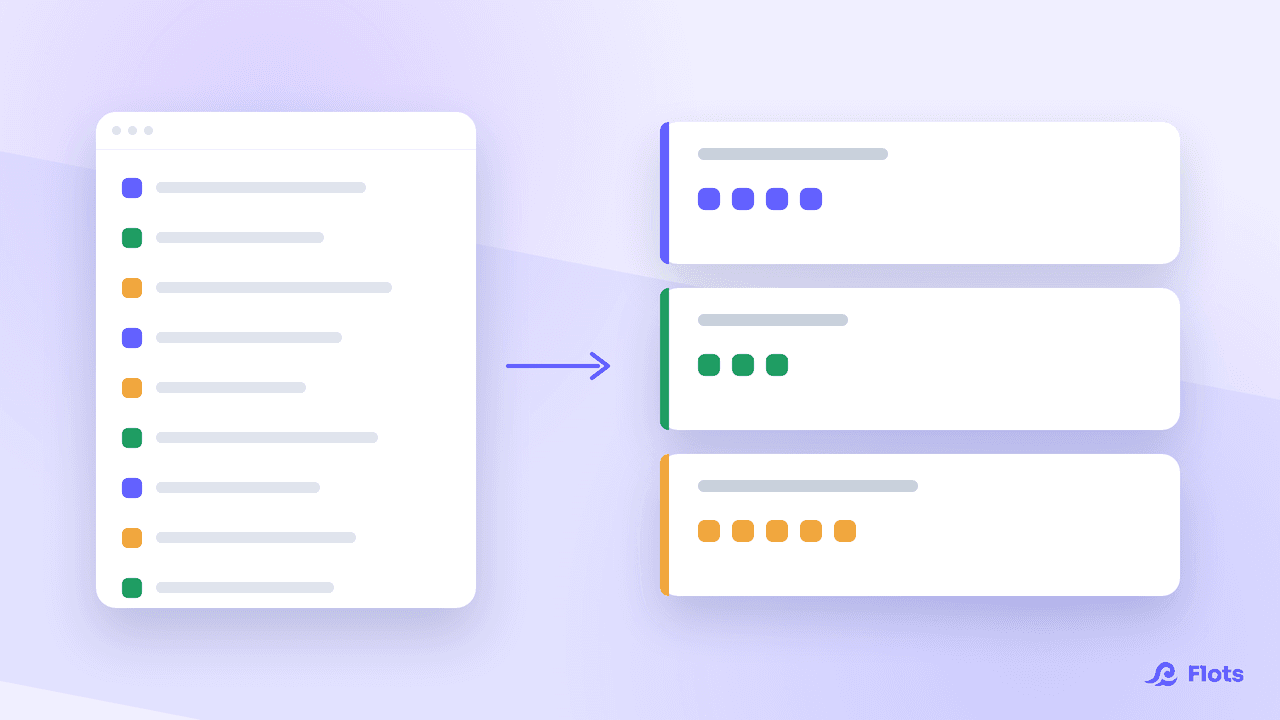
What you find instead is there the moment you open your account, with no structure to define. Tasks have a description, sub-tasks and a priority. Categories run across the whole space. Projects bring together tasks, notes and dated milestones, with collaborators invited onto them.
The calendar syncs with Google Calendar, accepts .ics feeds, and the Planning view puts tasks next to events. Notes are written in Markdown, export to PDF or Word, can be written by several people at once, and a meeting can come out of one as a set of tasks without leaving the note. There are also documents, whiteboards, and an AI assistant connected over MCP.
Airtable or Flots: the comparison
| Criterion | Airtable | Flots |
|---|---|---|
| Type of tool | Relational database and app layer | Day-to-day work organization |
| Getting started | Tables, fields and views to design | Structure ready the moment the account is created |
| Working with others | Billed per workspace collaborator, from the Commenter level up on Team | Collaborators invited project by project |
| Entry paid price | $20 per user per month (Team, annual) | €8 excl. tax per month (Individual), 2-month free trial, no credit card |
| Team price | $45 per user per month (Business, annual) | €20 excl. tax per user per month (Team) |
What to do now
Three moves are enough, and none of them commits you to leaving Airtable.
Export a full base and check that the result opens elsewhere. Count the people actually billed on your workspace, there are often more of them than expected. And ask yourself the usage question: if your bases are mostly lists of tasks and projects, you are paying for a database to meet an organization need.
The same reasoning applies to Bending Spoons' other tools, Evernote, already acquired, as much as Miro, whose acquisition is expected to close in the fourth quarter of 2026.
If you only do one thing this week, run the export: you will know exactly what you would take with you.
An organization tool ready to use, with no database to model.