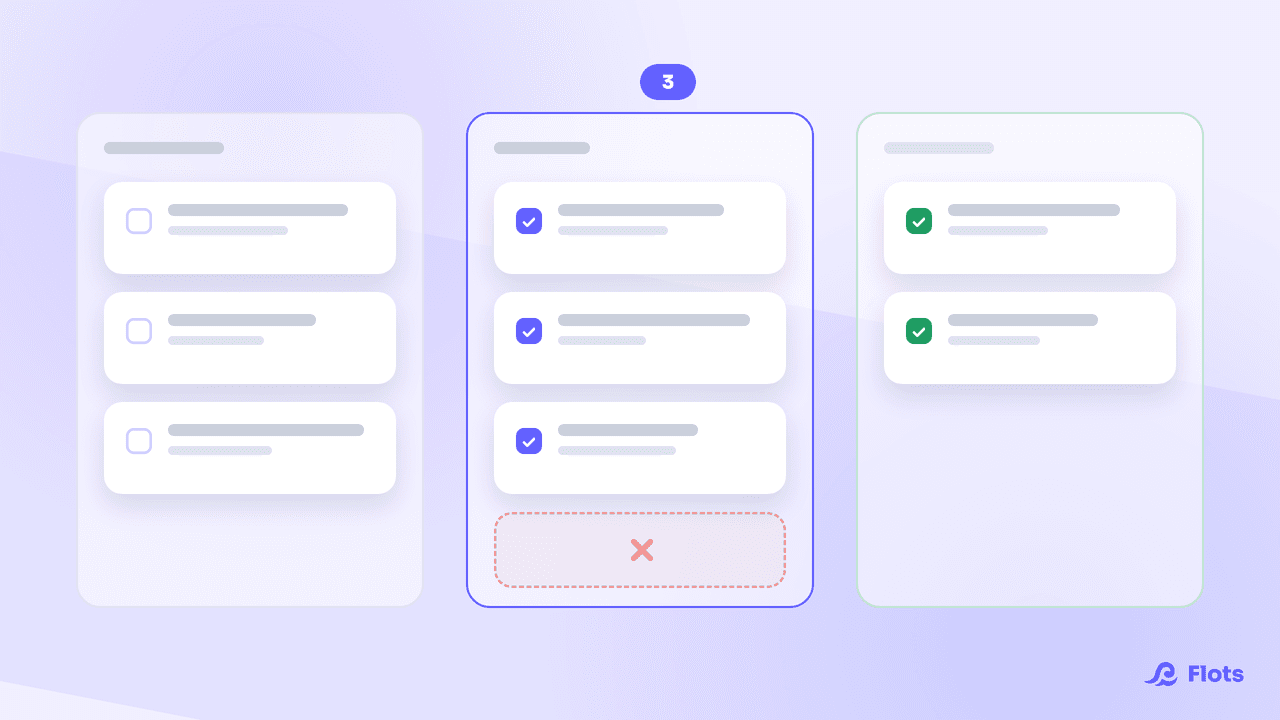
You have twelve things under way and none finished. Kanban deals with exactly that problem, with a single rule: you start nothing until you have finished something.
Where the Kanban method comes from
The Japanese word means "label" or "signboard". The method was born in Toyota's factories in the 1950s, driven by the engineer Taiichi Ōno, as Slack's overview of the Kanban method recalls.
Ōno watched how American supermarkets worked: shelves are restocked according to what customers have actually taken, not according to a forecast. He transposed the principle to the production line. A station only makes a part when the next station needs one, and signals it with a card.
Work stops being pushed from upstream and starts being pulled from downstream. David J. Anderson took that logic over for knowledge work from 2007 onwards, and the column board everybody knows came out of it. He keeps three principles from it, detailed by le-consultant-digital.com: transparency, limiting work in progress (WIP), continuous flow.
The three columns of a Kanban board
A minimal Kanban board fits into three states.
| Column | What it holds |
|---|---|
| To do | What has been identified but not started |
| In progress | What you are actually working on |
| Done | What is finished, and left visible |
Everything is decided in the In progress column. A classic task list hides how many things you have open in parallel. A board puts it in front of your eyes, and the number is often embarrassing.
The Done column, for its part, is the only place where completed work stays visible, in a system that otherwise only shows what is left to do.
The work in progress (WIP) limit
Without a cap, a Kanban board is only a list cut into three piles.
The rule: set a maximum number of cards allowed in the In progress column. Three, for example. When that cap is reached, you are not allowed to start a fourth. You have to finish one first.
The effect is immediate. Blocked tasks become visible, because they take up a slot you need. You start unblocking them instead of going around them by starting something else.

Three in progress, not four
The exact number matters less than having one at all. Three cards in progress is already a good starting point.
Why limiting work in progress works
Multitasking is expensive, and the cost is poorly perceived because it is paid in fragments.
Every open task takes up mental room, even when you are not working on it. And moving from one subject to another means reloading a context each time. Three projects run in parallel move much more slowly than the same three run one after the other.
Limiting the number of open fronts shortens the time a thing stays in suspense, without taking anything away from what you produce.
Applying Kanban without a dedicated board
An ordinary task tool is enough as soon as it offers statuses. In Flots, a task goes through to do, in progress and done: the three columns are already there, in another form.
Three habits turn those statuses into real Kanban.
Move a task to in progress the moment you start it, not the moment you think about it. The status has to reflect reality, otherwise it measures nothing.
Set your cap, and write it down somewhere. A limit you keep in your head is not a limit.
Look at the In progress column once a day. If a card has been sitting there for three days, it is blocked. Treat it as such.
Kanban and the other methods
Kanban gets along well with the rest, because it says nothing about choosing priorities. It organises the flow, not the decision.
So it combines with the Eisenhower matrix to sort what goes into the To do column, and with time blocking to book the time when cards actually move forward.
If you are hesitating between several approaches, our comparison is in choosing your productivity method.
Kanban can be tested in a week, without reorganising anything. Set a cap, hold it for five days, and watch what is really blocking.
Three statuses, one cap, and things move.